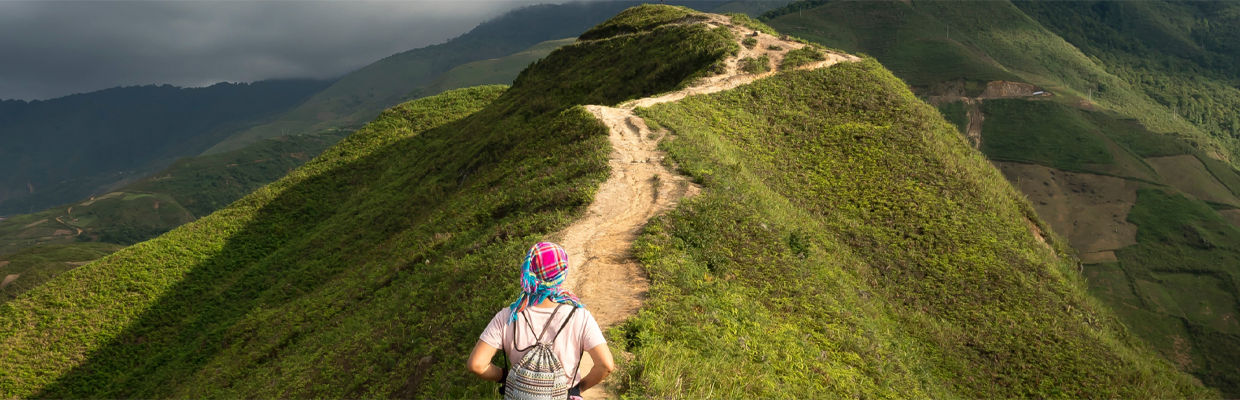

Andean textiles are not just ‘beautiful fabrics’: each piece is a true book woven in thread, preserving history, economy, ecology, and cultural resilience. In the Cusco region, especially in communities like Chinchero and Pisac, the textile tradition remains alive through techniques passed down from generation to generation, where every color, fiber, and design carries deep meaning.
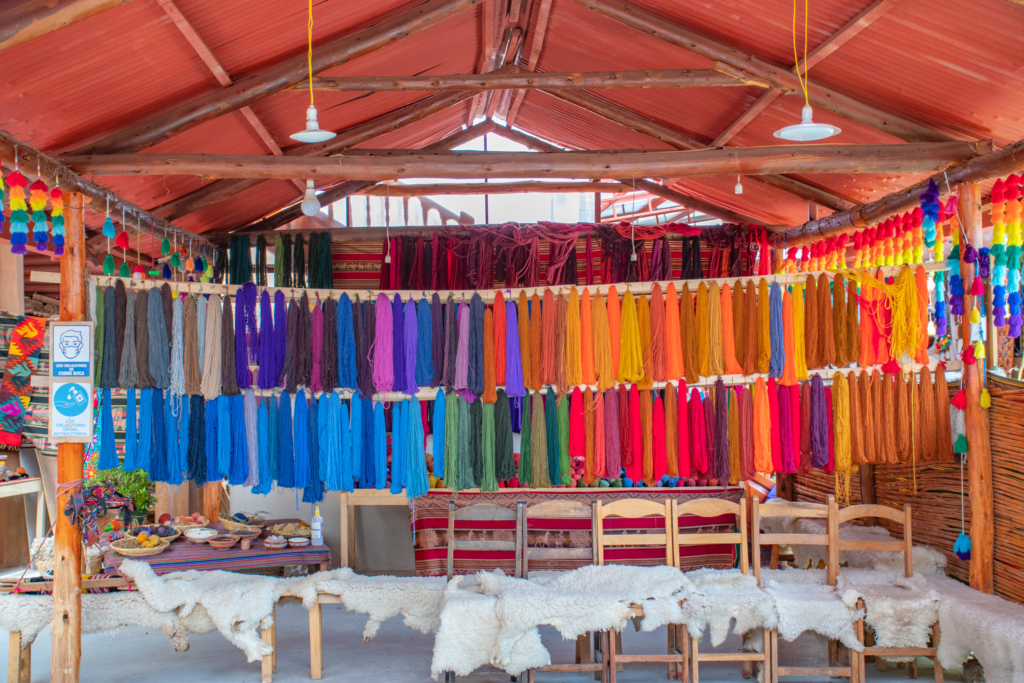
Saturated colors, geometric patterns that seem to carry their own code, and textures made to last. In the Cusco region (Chinchero, Pisac, Sacred Valley communities, and surrounding areas), the textile tradition is still alive: alpaca, llama, and—under regulated use—vicuña wool is spun; fibers are dyed with insects, roots, and plants; and woven on looms that date back to pre-Hispanic times but continue to be reinvented.
Fibers: Alpaca, llama, and vicuña (the latter is the finest and strictly regulated). Their properties vary: alpaca is warm and soft; vicuña, extremely rare and expensive.
Looms: The backstrap loom remains fundamental in many Andean villages for small and detailed pieces; there are also fixed and pedal looms depending on the place and the type of garment. These setups are not “antiques”: they allow for a precision in color and weave that is truly impressive.
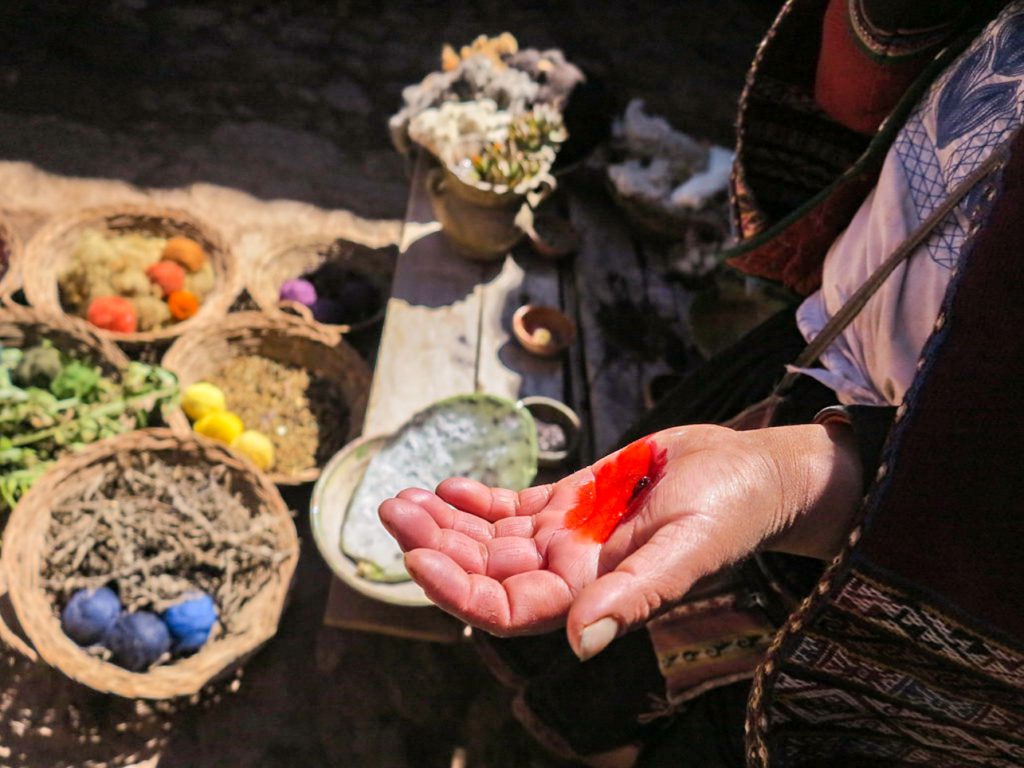
The traditional palette comes from insects, plants, roots, barks, and minerals. Some highlights include:
Cochineal
The tiny insect that produces red/crimson has been—and still is—fundamental. Today, Peru is one of the world’s largest exporters of processed cochineal. The color also changes depending on the mordant (the “fixer”) and the pH, which is why a single raw material can produce reds, fuchsias, and purples.
Despite being an insect, cochineal is now highly valued in natural cosmetics and foods—its economic importance goes far beyond the loom.

Indigo
The deep blue found in Andean textiles has a millennia-old history. Archaeological records show very ancient samples of indigo-dyed fabrics in the Andean region. Today, efforts are underway to recover local cultivation and dyeing processes.
The oldest known blue pigment in textiles dyed with indigo was discovered in Peru—placing the Andes among the very origins of indigo dyeing in the ancient world.
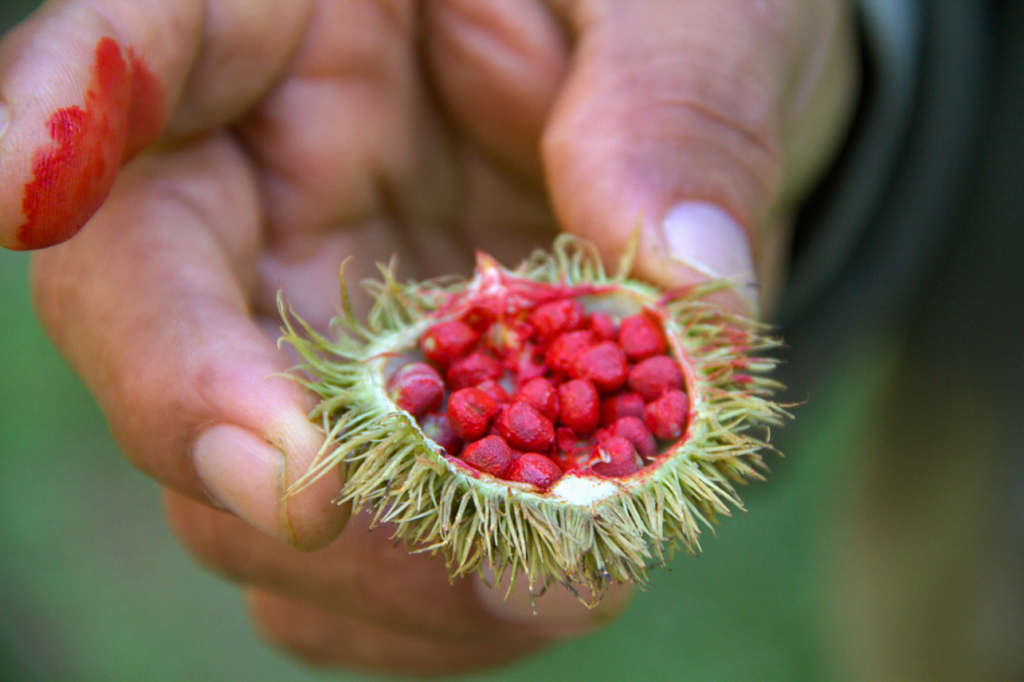
Annatto / Achiote
Used for yellows and oranges; barks and roots provide browns and blacks; while lesser-known plants (such as kinsa q’uchu) produce unique greens and teals. The mordanting technique (using mineral waters, ashes, or salts) is what fixes and transforms the color.
Some Andean colors are considered “impossible” to replicate exactly with synthetics due to their interaction with the fiber and the mordant. This is why many collectors highly value naturally dyed pieces.
The red from cochineal was not only valuable for textiles: it reached Europe during the colonial period and continued competing with synthetic dyes centuries later. Today, there is a global interest in natural cochineal (cosmetics, food, textiles), which brings new value to traditional techniques.
With the arrival of synthetic dyes in the 20th century, many communities abandoned natural dyeing because it was faster and cheaper. In recent decades, however, a revitalization has taken place: local and international projects, training centers, and tourism demand have fueled the recovery of natural dyeing as both cultural and economic heritage. It’s not a full return (there’s still a mix of methods), but it is a clear trend toward recovery.
Motifs are not random: they include cosmological symbols (snakes, mountains, constellations), records of kinship or origin, and signs of status. In places like Taquile (Lake Titicaca), weaving is so deeply integrated into social life that UNESCO declared it Intangible Cultural Heritage: there, technique and rules of transmission are part of the social contract. In Cusco, the variety of techniques (complementary warp-face, brocades, etc.) reflects a blend of pre-Hispanic heritage and colonial as well as modern adaptations.
If you want to live it firsthand, a practical and authentic option is to combine a Sacred Valley tour with a stop in Chinchero or at one of the workshops of the Centro de Textiles Tradicionales del Cusco (CTTC). A sample plan:
Morning departure from Cusco → visit to Chinchero (workshop and demonstration of spinning + natural dye baths). Visitors often take part: spinning, dyeing a skein, and learning how to set up the loom.
Stop in Pisac/Maras/Moray (archaeological context and landscapes).
Return to Cusco, with the opportunity to purchase pieces directly from weavers and associations (better prices and fairer for the community).
Andean textile art is a living blend of technique, color, and collective memory. Behind every piece lies knowledge of animals, plants, dye-bath chemistry, and social meaning. Exploring these textiles in Cusco is not just about “seeing”—it’s about learning a way of understanding the world, woven into thread.
Search